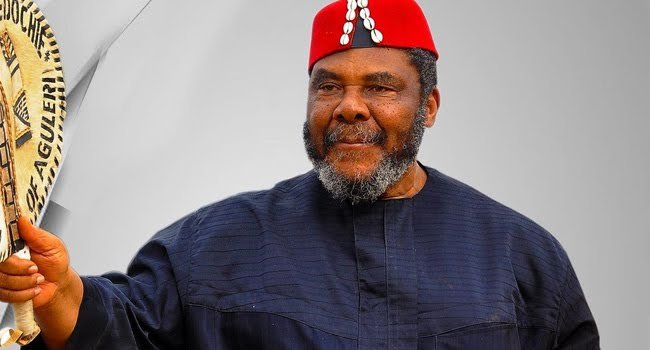
Pete Edochie’s voice is part of the furniture of Nigerian culture. Whether you know him from his portrayal of Okonkwo in the 1987 BBC/NTA adaptation of Chinua Achebe’s Things Fall Apart, still the definitive screen version of one of Africa’s most read novels, or from the thousands of Nollywood films that followed, the combination of his delivery and his physical presence has made him the go-to casting choice for any role requiring gravitas, wisdom, or authority. He has been doing this since before most of his co-stars were born.
He was born on 7 November 1947 in Enugu-Ukwu, Anambra State, and grew up in the Igbo cultural environment that gave him the linguistic authenticity and physical bearing that defined his most celebrated roles. His early career was in broadcasting, where he worked as a presenter and producer at the Nigerian Broadcasting Corporation before transitioning to acting in the 1980s.
Pete Edochie has been awarded national honours by the Nigerian federal government, received a UNESCO award for his contribution to African arts, and raised a family of performers that includes his sons Yul Edochie and Leo Edochie, both actors who have built their own careers in Nollywood. As of 2026, he remains an active performer and a figure of enormous symbolic importance to the Nigerian creative arts community.
Profile at a glance
Full name
Pete Edochie
Date of birth
7 November 1947
Birthplace
Enugu-Ukwu, Anambra State
Nationality
Nigerian
Education
Nigerian Broadcasting Corporation (NBC) School of Broadcasting, Enugu
Spouse
Josephine Edochie (married 1970s)
Children
5 sons, including actors Yul Edochie and Leo Edochie
National honours
MFR, OON (Officer of the Order of the Niger)
Active
1960s to present
Net worth estimate (2026)
~$4m to $6m (multiple entertainment sources; estimate, not verified)
Early life and broadcasting career
Pete Edochie was born on 7 November 1947 in Enugu-Ukwu, in the Anambra State area of southeastern Nigeria. His family was part of the Igbo community that had produced some of Nigeria’s most significant literary and intellectual figures, and his upbringing in that environment gave him an early appreciation for oratory, storytelling, and the formal use of language that characterises his screen presence.
He trained at the Nigerian Broadcasting Corporation School of Broadcasting in Enugu, which was one of the main routes into professional media work in Nigeria in the 1960s and 1970s. At the NBC, he developed skills in presentation, voice work, and production that transferred directly into his later acting career. He worked as a presenter and production hand at NBC for several years before his acting abilities began to attract specific attention.
His decision to pursue acting seriously came in the early 1980s, when Nigeria’s television drama scene was producing ambitious adaptations of Nigerian literary works. The quality of television drama at that point, supported by government broadcasting infrastructure, made it a viable and respected career path, and Pete Edochie’s NBC background positioned him well for the transition.
Things Fall Apart and cultural significance
The 1986 NTA television adaptation of Chinua Achebe’s Things Fall Apart cast Pete Edochie as Okonkwo, the proud, flawed Igbo warrior at the centre of Achebe’s novel. The performance is one of the most discussed in the history of Nigerian television. Edochie brought to Okonkwo a physical authority and emotional complexity that matched the scale of Achebe’s characterisation, and the production introduced generations of Nigerians to the novel through his interpretation of its central character.
Chinua Achebe himself praised Pete Edochie’s performance and reportedly described it as the definitive screen rendering of Okonkwo. The production was broadcast nationally and internationally and remains a reference point in discussions of Nigerian cultural achievement in the arts. For viewers who encountered Things Fall Apart through the television adaptation before reading the novel, Pete Edochie’s physicality and voice are often inseparable from their understanding of Okonkwo as a character.
The success of Things Fall Apart established Pete Edochie as a national cultural figure, not merely an entertainment personality. His capacity for speaking in literary Igbo, his physical bearing, and his ability to communicate authority through stillness and understatement gave him a screen presence that subsequent Nigerian actors have studied and cited as a reference point for how to play depth and gravitas.
Nollywood career
When Nollywood’s video film industry began its rapid expansion in the 1990s, Pete Edochie was among the experienced actors who transitioned from television into the new format. His roles in Nollywood films consolidated the authoritative father and elder figure that his television work had established, and directors recognised that his presence in a production communicated a level of seriousness that elevated surrounding performances.
His most-cited Nollywood work includes appearances in Ikuku, Domitilla alongside RMD, and numerous productions through the 2000s and 2010s in which he played patriarchal figures with complex moral dimensions. He has appeared in more than 200 Nollywood productions across his career, a filmography that places him among the most prolific actors in the industry’s history alongside his artistic reputation.
In more recent years, his appearances have become more selective, and he has spoken in interviews about preferring roles that challenge him over volume of output. He has appeared in Netflix-distributed Nollywood productions and in productions associated with the new generation of Nigerian filmmakers who are bringing higher production values and more complex narratives to the industry.
Away from work
Pete Edochie married Josephine Edochie in the 1970s, and the couple have five sons. Two of them, Yul Edochie and Leo Edochie, have pursued acting careers of their own. Yul Edochie has become one of the more prominent younger Nollywood actors of his generation, while also attracting personal controversy in recent years over his publicly disclosed second marriage, a matter that Pete Edochie has addressed in media interviews.
He has spoken about his Igbo heritage and his Catholic faith as twin pillars of his identity and values. His public statements on family, marriage, and morality are frequently quoted in Nigerian social media discourse, where he is regarded as a traditional authority voice in conversations about Nigerian cultural values.
Awards and recognition
Pete Edochie has received the national honour of MFR (Member of the Order of the Federal Republic) and the OON (Officer of the Order of the Niger) from the Nigerian government. He received a UNESCO award for his contribution to African arts, one of the highest international recognitions an African performing artist can receive. He has won lifetime achievement awards at the Africa Movie Academy Awards, City People Movie Awards, and multiple other Nigerian entertainment institutions.
He holds honorary doctorates from Nigerian universities and has been cited in academic studies of African cinema and literature as one of the defining interpreters of Igbo cultural heritage on screen. His proverbs and aphorisms, delivered in character and in interviews, are widely quoted in Nigerian popular culture and social media.
Earnings and reported net worth
Pete Edochie’s 2026 net worth is estimated at between $4 million and $6 million by multiple Nigerian entertainment sources. The figure reflects decades of television and film income, brand endorsements, speaking engagement fees, and real estate holdings accumulated over a career spanning more than fifty years. His income from newer streaming platform productions supplements his historical earnings.
As one of Nigeria’s most culturally significant entertainers, he commands high fees for corporate appearances, national celebrations, and cultural events. His brand as an authoritative elder figure makes him a sought-after spokesperson for Nigerian companies in the financial services, telecoms, and consumer goods sectors.
Selected works
Things Fall Apart (1987 television series)
The Battle of Musanga
Half of a Yellow Sun (2013)
Lionheart (2018)
Frequently asked questions
What is Pete Edochie most famous for?
He is most celebrated for his portrayal of Okonkwo in the 1986 NTA television adaptation of Chinua Achebe’s Things Fall Apart, a performance that Achebe himself praised as the definitive screen rendering of the character. He has since appeared in over 200 Nollywood films and remains active in Nigerian film and television.
Where was Pete Edochie born?
He was born on 7 November 1947 in Enugu-Ukwu, Anambra State, southeastern Nigeria. He trained at the Nigerian Broadcasting Corporation School of Broadcasting in Enugu and worked as a presenter and producer at NBC before transitioning to a full acting career in the 1980s.
Which of his sons are actors?
Two of his five sons, Yul Edochie and Leo Edochie, have pursued acting careers in Nollywood. Yul Edochie has become one of the more prominent younger Nollywood actors of his generation and has also entered politics, running, unsuccessfully, for governor of Anambra State.
What awards has Pete Edochie received?
He has received national honours including the MFR and OON from the Nigerian government, a UNESCO award for contribution to African arts, lifetime achievement awards from the Africa Movie Academy Awards and City People Movie Awards, and honorary doctorates from Nigerian universities.
What is Pete Edochie’s net worth in 2026?
Multiple Nigerian entertainment sources estimate his net worth at between $4 million and $6 million as of 2026, built from over five decades of television and film income, brand endorsements, speaking engagement fees, real estate, and streaming platform production income.
Conclusion
Pete Edochie is among the most revered actors Nigeria has produced. He is celebrated for his gravitas and command of Igbo idiom. That authority has defined his screen presence.
His portrayal of Okonkwo in the television adaptation of Things Fall Apart established a standard that shaped his career. It became one of his most celebrated roles. That performance cemented his reputation early.
A patriarch of Nollywood, he remains one of its most respected and recognisable figures. He has appeared in a vast number of productions. His standing in the industry is unmatched by many.
Sources and further reading
Information in this profile draws on reporting and data from Africa Movie Academy Awards, UNESCO arts recognition records, The Punch, Vanguard, City People Movie Awards, NTA broadcast archives, and Nigerian government national honours records.
Max Adeyemi is a Lagos-based writer covering Nigerian and African entertainment, sport, business, and culture. He has spent over a decade tracking the careers, controversies, and quiet achievements of the people who move the culture. He writes all profiles on Nolly.