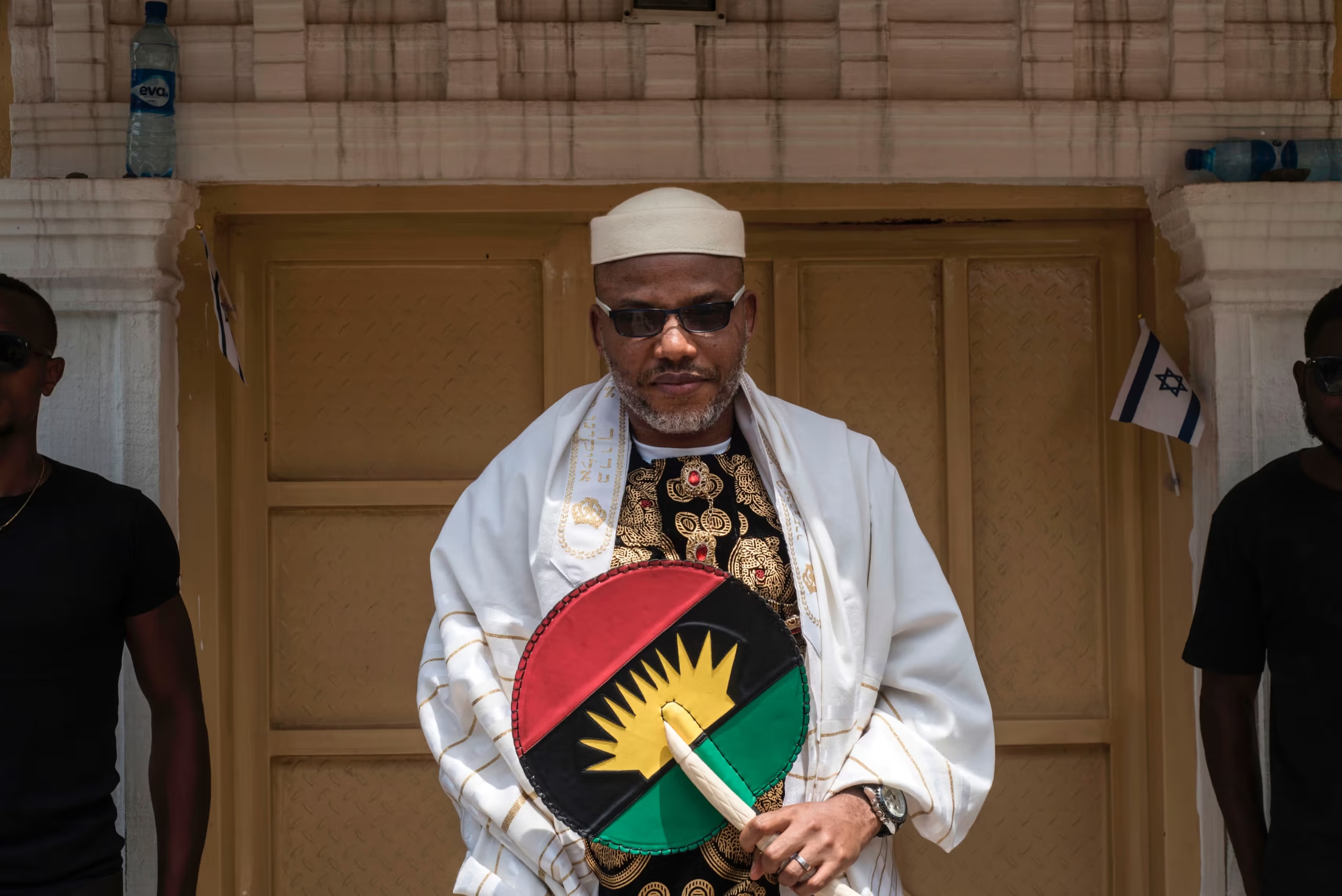
Nnamdi Kanu is the most divisive figure in contemporary Nigerian politics who does not hold elected office. The founder and leader of the Indigenous People of Biafra (IPOB) has been the primary voice of Igbo separatism in Nigeria since the early 2010s, using Radio Biafra from the UK and later from Nigeria to broadcast arguments for an independent Biafra state. His arrest, bail, flight from Nigeria in 2017, re-arrest in Kenya in 2021, and ongoing legal proceedings in Abuja have each generated intense political debate about sovereignty, self-determination, and the limits of federal authority in Nigeria.
Kanu is the founder and leader of the Indigenous People of Biafra (IPOB), the secessionist movement he established in 2012 to advocate for the independence of a Biafra state from Nigeria. He is also a former director of Radio Biafra, the broadcaster that carried much of IPOB’s messaging through the 2010s.
Nnamdi Okwu Kanu was born on 25 September 1967 in Abia State. He holds British citizenship in addition to his Nigerian nationality, which has been at the centre of multiple diplomatic disputes over his successive arrests. He is married to Uchechi Okwu-Kanu and identifies as an Igbo Jew.
This profile sticks to publicly verifiable facts: court rulings, dates, and the on-the-record positions of the parties involved. It does not take a position on the underlying political dispute over Biafran separatism.
At a glance
Full name
Nnamdi Okwu Kanu
Date of birth
25 September 1967
Age (2026)
58 (turns 59 on 25 September 2026)
Place of birth
Isiama Afaraukwu, Umuahia, Abia State, Nigeria
Heritage
Igbo
Religious identity
Igbo Jew
Nationality
Nigerian and British (dual)
Spouse
Uchechi Okwu-Kanu
Founded
Indigenous People of Biafra (IPOB), 2012
Notable role
Former director, Radio Biafra
Current legal status (2026)
Serving life sentence; appeal pending
Early life and family
Nnamdi Kanu was born on 25 September 1967 in Isiama Afaraukwu, a village in the outskirts of Umuahia, the capital of Abia State in Nigeria’s south-east. His birth came just months into the Nigerian Civil War of 1967 to 1970, which was being fought over the very Biafran secession that Kanu would later revive as a political cause four decades later.
His father, Eze Israel Okwu Kanu, was the traditional ruler of Isiama Afaraukwu. The family held significant standing in the local community as part of the chieftaincy structure that survived the war.
His mother, Ugoeze Sally Kanu, was a community organiser and a long-running figure in Isiama Afaraukwu’s women’s networks. Both parents would later appear in public defence of their son during his early detention years.
Education and the move to the United Kingdom
Kanu was educated locally in Abia State for his primary and secondary education. The post-civil-war south-east was an economically constrained environment, and his family channelled significant resources into his schooling.
He moved to the United Kingdom in the 1990s for further education and work. He eventually settled in the UK and acquired British citizenship through residence. He has been described in court filings and his own broadcasts as a British-Nigerian dual national, a status central to several of the diplomatic disputes around his subsequent arrests.
His exact educational record in the UK has been the subject of some dispute, with court filings and his own published material citing studies at the London School of Economics that the LSE has, on occasion, declined to confirm.
Founding IPOB and Radio Biafra
Kanu founded the Indigenous People of Biafra (IPOB) in 2012 to revive the cause of the short-lived Republic of Biafra, which had seceded from Nigeria in 1967 and was reintegrated after the Nigerian Civil War of 1967 to 1970.
He began broadcasting on Radio Biafra, an internet and shortwave radio station whose programming Nigerian security agencies characterised as inflammatory and which IPOB and its sympathisers characterised as legitimate political expression. The station ran from a London base for several years.
The Nigerian government proscribed IPOB as a terrorist organisation in 2017. IPOB and several international Igbo diaspora groups have publicly rejected the designation. The European Union has not adopted the Nigerian proscription, and the British government has continued to engage Kanu’s case under its consular access framework for British citizens abroad.
The 2015 Lagos arrest and 2017 bail
Kanu was first arrested in Lagos on 14 October 2015, on a range of charges that included treason, treasonable felony, and operating an unlawful society. He remained in Department of State Services (DSS) detention even after Federal High Court orders directing his release.
On 28 April 2017, the Federal High Court granted him bail. The bail conditions included a prohibition on holding any rally or interview, restrictions on the size of gatherings he could host at his Abia State home, and limits on travel.
In September 2017, a Nigerian military operation around his family compound in Isiama Afaraukwu was reported in the Nigerian and international press. Kanu left Nigeria in the immediate aftermath and remained outside the country until June 2021.
The 2021 Kenya rendition
In June 2021, Kanu was apprehended in Nairobi, Kenya, and transported to Nigeria under disputed circumstances. The Nigerian government has described the operation as a coordinated international intelligence effort.
Kanu’s legal team has consistently described the operation as an extraordinary rendition carried out without due process. He has himself maintained that characterisation in subsequent court appearances.
In April 2024, Interpol publicly denied any involvement in the operation, contradicting earlier Nigerian government statements that had linked the agency to the arrest. The Court of Appeal in Abuja had ruled in 2022 that the extraordinary rendition vitiated the case against him, before the Supreme Court reinstated the charges on procedural grounds.
The 2025 trial and conviction
After four years of legal proceedings, the Federal High Court in Abuja convicted Kanu and sentenced him to life imprisonment on 20 November 2025. The charges that produced the conviction included terrorism, broadcasting falsehoods, and the importation of equipment used for radio broadcast.
The verdict was reported in detail by the BBC, Reuters, and Premium Times.
Kanu’s lead counsel, Aloy Ejimakor, has stated publicly that the defence intends to appeal the conviction at the Court of Appeal and, if necessary, the Supreme Court of Nigeria. As of mid-2026, that appeal is reportedly pending.
The conviction prompted statements from the Igbo socio-cultural group Ohanaeze Ndigbo, which called for clemency, and from the British government, which through the Foreign, Commonwealth and Development Office reiterated that as a British citizen, Kanu is entitled to consular access. Several Nigerian senators from the South-East geopolitical zone have publicly called for a political solution to the wider dispute.
Family and personal life
Kanu is married to Uchechi Okwu-Kanu. She has been one of the most prominent advocates for his release through international media interviews since 2017, and has made representations on his case to the UK Foreign Office, the European Parliament, and Igbo diaspora organisations in the United Kingdom and the United States.
The couple have children whose identities have been kept out of the public record at the family’s request, a detail respected by both Nigerian and UK press coverage.
Kanu identifies as an Igbo Jew, a religious identification rooted in the historical claim by some Igbo communities of descent from one of the Lost Tribes of Israel. He has worn Jewish prayer shawls and head coverings during court appearances on multiple occasions.
Public reception
Reading the wider response to Kanu’s case requires holding several positions in tension. Within the Nigerian security establishment, IPOB and its armed offshoot, the Eastern Security Network (ESN), have been associated with attacks on police and military installations in the South-East between 2021 and 2024. IPOB has alternately denied or attributed those attacks to “unknown gunmen” exploiting its name.
Among large segments of the Igbo population both inside Nigeria and in the diaspora, Kanu is regarded as a political prisoner whose detention and trial have not met the standard of due process that his dual British citizenship would normally entitle him to.
International human-rights organisations including Amnesty International have expressed concern about aspects of the trial process without endorsing Kanu’s separatist programme. The European Parliament has passed resolutions calling for his release without taking a position on Biafran independence.
Common questions
Who is Nnamdi Kanu?
Nnamdi Okwu Kanu, born 25 September 1967, is the founder and leader of the Indigenous People of Biafra (IPOB), the secessionist movement he established in 2012. He was also the director of Radio Biafra, the broadcaster that carried much of IPOB’s messaging through the 2010s. He is a Nigerian and British dual citizen.
What is IPOB?
The Indigenous People of Biafra is a separatist organisation founded by Kanu in 2012 to advocate for the independence of a Biafra state from Nigeria. The Nigerian government proscribed it as a terrorist organisation in 2017, a designation that is contested. The European Union has not adopted the proscription.
When was Nnamdi Kanu sentenced?
The Federal High Court in Abuja sentenced him to life imprisonment on 20 November 2025 on terrorism-related charges. An appeal at the Court of Appeal is reportedly pending. The verdict was reported by the BBC, Reuters, and Premium Times.
Was Nnamdi Kanu arrested in Kenya?
He was apprehended in Nairobi in June 2021 and transported to Nigeria. His legal team has consistently characterised the operation as an extraordinary rendition carried out without due process. Interpol publicly denied any involvement in the operation in April 2024.
Is Nnamdi Kanu a British citizen?
Yes. He holds British citizenship in addition to his Nigerian nationality. The UK Foreign, Commonwealth and Development Office has confirmed his entitlement to consular access. The dual citizenship has been the basis for several diplomatic representations on his behalf since 2017.
Conclusion
Nnamdi Kanu became one of the most prominent and divisive figures in Nigeria’s separatist politics. As the leader of the Indigenous People of Biafra, he built a large following through Radio Biafra and online broadcasts. His campaign for Biafran independence placed him at the centre of a long-running national controversy.
His legal troubles, including his arrest, time abroad and subsequent prosecution, kept him in the headlines for years. The circumstances of his return to Nigeria to face trial drew significant legal and diplomatic attention. His case became a focal point for debates about the state and self-determination.
To his supporters he is a champion of a marginalised cause, while to his critics he is a destabilising influence. That deep division defines how he is viewed across the country. His story remains bound up with one of Nigeria’s most sensitive political questions.
Sources consulted
BBC News, “Nnamdi Kanu sentenced to life for terrorism” (20 November 2025)
Reuters Africa, IPOB and Biafra-related legal coverage
Premium Times, Nnamdi Kanu trial coverage 2021 to 2026
Amnesty International, Nigeria human rights reports
European Parliament, resolutions on Nigeria (2022 to 2024)
UK Foreign, Commonwealth and Development Office, consular statements
Federal High Court of Nigeria, case records FHC/ABJ/CR/383/2015 and successors
This article is editorial and neutral. It does not endorse the position of any party in the IPOB / Federal Government dispute. Corrections welcomed at hello@nolly.com.ng.
Max Adeyemi is a Lagos-based writer covering Nigerian and African entertainment, sport, business, and culture. He has spent over a decade tracking the careers, controversies, and quiet achievements of the people who move the culture. He writes all profiles on Nolly.