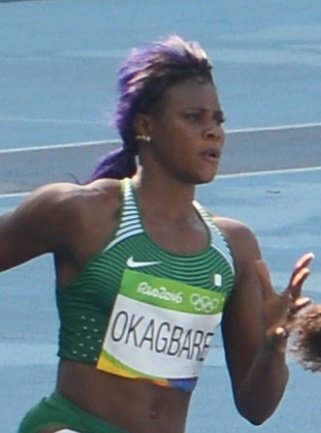
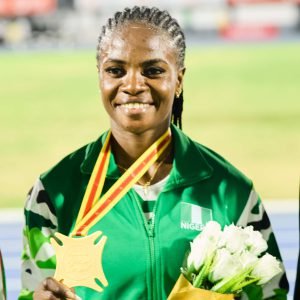
Blessing Okagbare spent more than a decade as one of the most decorated female athletes in Nigerian and African sports history, winning medals across the 100 metres, 200 metres, and long jump at Olympics, Commonwealth Games, and World Athletics Championship level. She combined pace, explosive power, and technical quality across three events in a way that is extremely rare, and for the period 2010 to 2020 she was consistently among the world’s top five women across two sprinting distances.
She was born on 9 October 1988 in Sapele, Delta State, and began her athletics career as a long jumper before transitioning to sprint events where her raw speed proved even more effective. Her 2008 Olympic debut in Beijing produced a long jump bronze medal when she was 19, and the decade that followed built on that early international credibility with one of the most decorated careers in Nigerian athletics history.
Her career was brought to a halt in 2021 when she tested positive for human growth hormone at the Tokyo Olympics and received a 10-year ban that was later confirmed through additional proceedings. The ban ended a career at its zenith and is the defining controversy of Nigerian women’s athletics in the past decade. She has maintained her position on the matter in public statements.
Profile at a glance
Full name
Blessing Okagbare-Ighoteguonor
Date of birth
9 October 1988
Birthplace
Sapele, Delta State
Nationality
Nigerian
Events
100m, 200m, long jump
Olympic medals
Bronze, long jump, 2008 Beijing Olympics
Commonwealth Games
Multiple gold medals (100m, 200m, long jump)
World Athletics 200m silver
2013 Moscow
Ban
10-year ban from 2021 for doping violations
Net worth estimate (2026)
~$500k to $1.5m (multiple sources; estimate, not verified)
Early life and athletic origins
Blessing Okagbare was born on 9 October 1988 in Sapele, a city in Delta State in Nigeria’s Niger Delta region. She showed exceptional athletic ability from childhood, particularly in the jumping and sprinting events that would define her career. Sapele’s secondary schools and the Delta State athletic development system provided the initial competitive environment where her talent was first formalised.
Her talent earned her a scholarship that brought her into the higher-performance training environments necessary to reach international competition standard. She relocated to the United States to train under coaches with international championship experience, a move that was essential for developing the technical precision her events demanded at the top level. The American training environment shaped her into the complete multi-event sprinter she became.
Her early international profile was built as a long jumper, and it was in that event that she made her Olympic debut. The 2008 Beijing Games gave her a bronze medal in the long jump when she was just 19, an achievement that placed her among the best young athletes in the world in that discipline and validated the investment in her development that had preceded it.
Career achievements
Across the decade from 2010 to 2020, Blessing Okagbare was one of the dominant figures in women’s sprinting and jumping worldwide. At the 2013 World Athletics Championships in Moscow, she won the silver medal in the 200 metres, demonstrating that her sprint speed was competitive at the highest global level. She also won the 100 metres at the 2013 Diamond League final in Zurich with a performance time that ranked among the fastest by a Nigerian woman in history.
At Commonwealth Games level, she was exceptional, winning gold medals in the 100 metres, 200 metres, and long jump across the 2010 and 2014 editions, a multi-event gold haul that demonstrated the exceptional range of her athletic ability. No other African female athlete in the modern era has been as competitive across three events at the same time at championship level.
She was a regular Diamond League winner and finalist across the 2012 to 2020 period, performing against the world’s fastest women on the circuit and producing times that placed her consistently in the global top five. Her combination of elite long jump ability and elite sprint speed made her a unique figure in world athletics, and she was widely regarded as one of the sport’s most exciting performers when at her best.
The 2021 Tokyo ban
Blessing Okagbare’s career ended abruptly in August 2021 when she received a provisional suspension from the Athletics Integrity Unit (AIU) after testing positive for human growth hormone during out-of-competition testing before the Tokyo Olympics. She had already competed in the 100 metres first round at Tokyo and was due to run in the semi-final when the suspension was announced publicly.
Subsequent proceedings added further violations to the original charge, including failure to cooperate with the investigation, and the eventual sanction was a 10-year ban. The length of the ban effectively ended her career at the age of 32. Nigerian sports fans and officials expressed a range of reactions, from disappointment to disbelief, and the case generated sustained discussion about the pressures on athletes and the testing infrastructure in Nigerian athletics.
Okagbare has made public statements contesting elements of the process and the sanction. The controversy remains the defining public issue of her career and has been covered extensively by athletics media internationally. Her achievements on the track before 2021 stand as a separate part of her record, recognised by those who covered her career through its decorated prime years.
Family and personal life
Blessing Okagbare has been married and uses the hyphenated surname Okagbare-Ighoteguonor. She has kept the details of her personal life largely private, consistent with a general approach to media that focused on performance rather than personal narrative during her competitive years. She has been based primarily in the United States during her athletic career, where her training environment and coaching relationships were established.
She has represented Delta State and Nigeria in multiple public celebrations of athletic achievement and was received at state functions in Abuja and Asaba during her peak competitive years. Her Sapele origins and her status as one of the most decorated athletes Delta State has produced are consistently noted in the state’s cultural and sporting accounts of its public figures.
Reported net worth
Blessing Okagbare’s net worth is estimated at between $500,000 and $1.5 million by multiple sources, reflecting the prize money and sponsorship income accumulated during her competitive career from 2008 to 2021. Track and field generates lower commercial income than team sports, but her Diamond League prize money, Commonwealth Games and World Athletics performance bonuses, and her Adidas equipment sponsorship during peak years contributed to career earnings at the upper end of what Nigerian athletics produces. Her earnings since the 2021 ban have been significantly reduced.
People also ask
What events did Blessing Okagbare compete in?
She competed at elite level in the 100 metres, 200 metres, and long jump, which is an exceptionally rare multi-event combination at world-class standard. Her Olympic debut was in long jump at the 2008 Beijing Games, where she won bronze, and she subsequently became equally competitive in both sprint distances at World Athletics and Diamond League level.
What was Blessing Okagbare’s biggest achievement?
Her 2013 World Athletics Championships 200 metres silver medal in Moscow and her multiple Commonwealth Games gold medals across three events are among her highest achievements. She was also ranked in the global top five across multiple sprint and jump events at the same time during her peak years from 2013 to 2019.
Why was Blessing Okagbare banned?
She received a 10-year ban from 2021 following a positive test for human growth hormone during out-of-competition testing before the Tokyo Olympics, combined with additional violations including failure to cooperate with the investigation. The ban effectively ended her career at age 32 and was the subject of significant media coverage and public debate in Nigeria.
Where is Blessing Okagbare from?
She was born on 9 October 1988 in Sapele, Delta State, in Nigeria’s Niger Delta region. She is one of the most decorated athletes Delta State has produced, and her achievements were celebrated at state functions in Asaba and Abuja during her competitive peak.
What is Blessing Okagbare’s net worth?
Multiple sources estimate her net worth at between $500,000 and $1.5 million, reflecting Diamond League prize money, championship performance bonuses, and equipment sponsorship income accumulated during her career from 2008 to 2021. Her earnings have been significantly reduced since the 2021 ban.
Conclusion
Blessing Okagbare was for years a trailblazer for Nigerian women’s sprinting. At her peak she was competitive at world level in both the sprints and the long jump. That versatility set her apart among her contemporaries.
She was a global medallist whose records stood as markers for the next generation. Her talent made her one of the country’s most prominent athletes. For much of her career she was a genuine standard-bearer.
Her legacy, however, is complicated by a lengthy doping ban that ended her elite career. Any account of her achievements now sits alongside that sanction. Her story stands as a cautionary chapter in African athletics.
Sources consulted
Information in this profile draws on reporting and data from World Athletics (worldathletics.org), Athletics Integrity Unit (AIU) case records, Commonwealth Games Federation, BBC Sport, The Guardian, The Punch Nigeria, Diamond League official results, and Guardian Nigeria.
Max Adeyemi is a Lagos-based writer covering Nigerian and African entertainment, sport, business, and culture. He has spent over a decade tracking the careers, controversies, and quiet achievements of the people who move the culture. He writes all profiles on Nolly.